
Lessons in Everyday Alchemy
Prefer to listen to this letter? You can find an audio version here ⬆️
I’m feeling the first the wisps of autumn rippling through the air as we move through these final weeks of summer. And what an inflamed, fiery, consumptive summer it has been in this year of the Fire Horse.
In the midst of digesting the gravity of the immense destruction and dissolution that is dizzyingly upending and shapeshifting so many lives and communities around the world right now, my mind and consciousness have been occupied by the topics of fire, heat, alchemy, and metamorphosis. I recently read (and then promptly re-read) Paulo Coelho’s classic book The Alchemist, which has offered a lot of inspiration as I have been undergoing my own metamorphosis this summer.
Sharing these thoughts about alchemy and metamorphosis feels important because they have come to shape how I want to approach my own work in the world as a facilitator, coach, and guide of somatic awareness and embodied tending.
Alchemy is often associated with the esoteric practice of transmuting base metals, such as lead, into gold as they are melted, mixed, and molded over a fire.
In the novel The Alchemist, we follow our protagonist, “the boy” on his heart-led journey through the Sahara desert to discover his “Personal Legend” that, for him, is a treasure he dreamed about near the Egyptian pyramids. As he sets out on his journey, he learns from a fellow caravan traveler, “the Englishman,” that an alchemist lives in the desert. The Englishman is determined to meet and study with the alchemist so he can crack the code of alchemy — the books haven’t been able to do it for him. While the Englishman barely looks up from his books during the desert journey, the boy stays present with the journey, studying the camels, his fellow travelers, and - most attentively - the desert itself. He tries to read some of the Englishman’s books on alchemy, which he found “strange,” and the Englishman tried to study the caravan and desert, “but he hadn’t learned anything new” from observing them. As the boy reflected on his own journey which had posed many challenges but also propelled him closer to his Personal Legend, he “was becoming more and more convinced that alchemy could be learned in one’s daily life.”
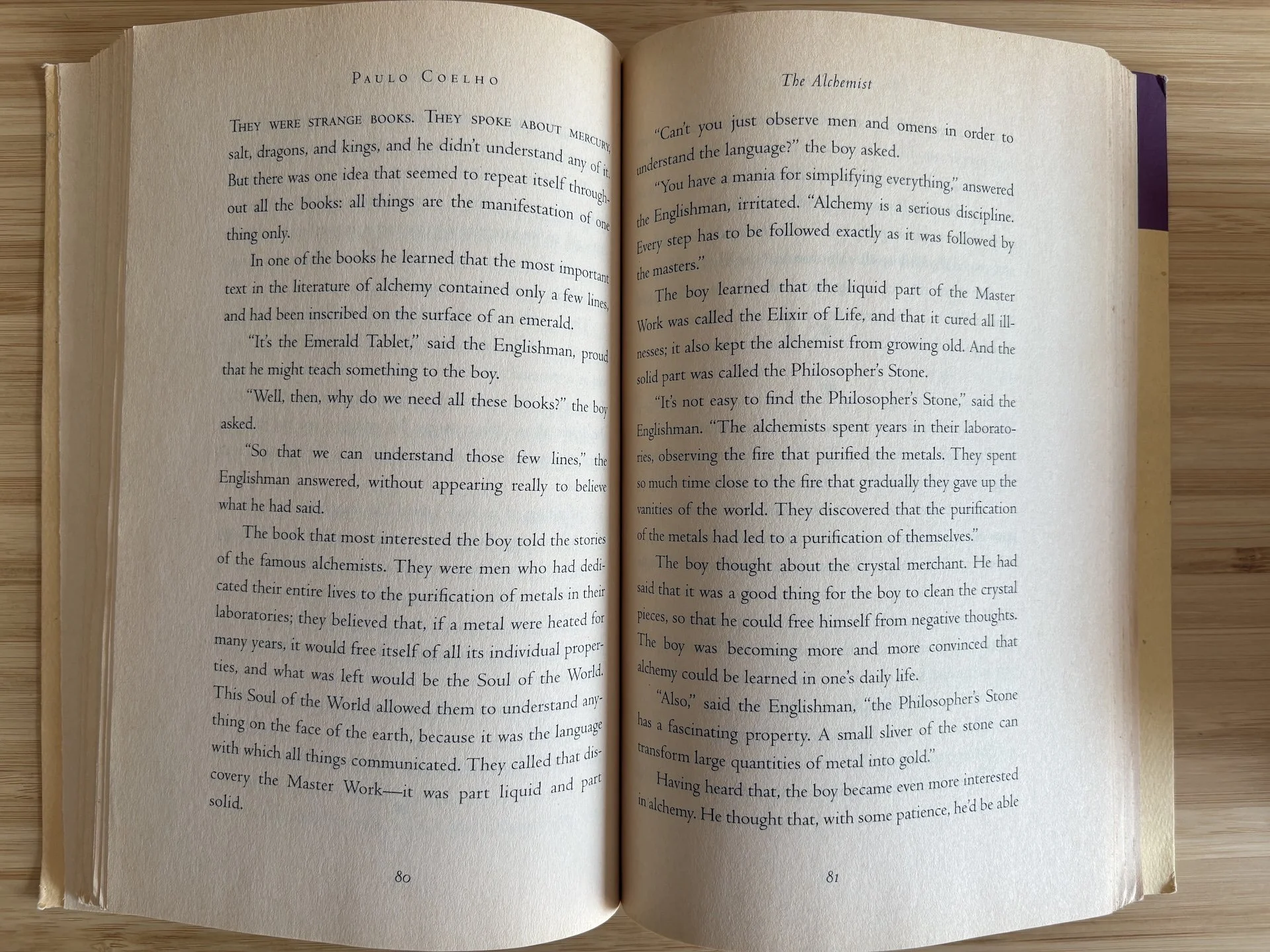
“The boy was becoming more and more convinced that alchemy could be learned in one’s daily life” - The Alchemist by Paulo Coelho
The takeaway here is that if one solely focuses on mastering alchemy for the intellectual knowledge or the material gain of the gold coin (like the Englishman), the secrets of alchemy will remain locked away. Alchemy reveals its secrets to individuals (like the boy) who offer their presence and attention to the raw, base details they encounter as they journey through life.
Just as the boy attends to the desert day after day, carefully studying its rhythms and patterns as their caravan crosses through the desert, we might think of ourselves traveling through the “desert” of life. The boy observes that the “’caravan and the desert speak the same language, and it’s for that reason that the desert allows the crossing. It’s going to test the caravan’s every step to see if it’s in time, and if it is, we will make it to the oasis.’” If I play around with this line and substitute my own self as being like “the caravan” and my own life journey and being like “the desert,” it makes me curious about how my life and I can communicate with each other and (try) to “speak the same language” as life inevitably tests me along the way.
The alchemy of everyday life may look like transforming raw vegetables into a flavorful soup, having an immersive conversation with a friend, or stewing on a problem until it clarifies itself into a solution. Alchemy occurs when we bring our presence and attention to the base, raw moments and situations we encounter on our life journey — particularly those that turn up the heat under our vulnerable human vessel, melt us down, and morph us into a new form. An alchemist might add that if we gently and consciously tend to our heated human vessel throughout the transmutation process, our new form may have a golden sheen.
To be clear, I don’t believe everything happens for a reason, and it is not my intention to suggest that all challenges have a golden solution. But I think applying an alchemical lens to a challenging life situation invites us to become more curious and creative in the midst being melted by a figurative fire, all the while holding a modicum of trust that as we emerge from the fire, we will be re-formed — stronger, wiser, and a bit more golden.
Nature’s supreme alchemists - butterflies - have been wafting through my garden, steadying themselves on zinnias and demonstrating what can emerge from the goo after self-dissolution. While I had a general sense of the lifecycle of a butterfly, I dug into the details a bit more and wanted to share them with you in case you’d like a refresher too:
The mother butterfly lays its eggs on a leaf. Upon hatching, the baby caterpillar gorges on leaves for about two weeks, and then it attaches itself to a stem and hangs upside down in a “J” shaped surrender-like pose. Then, the caterpillar’s skin peels away as the chrysalis forms around it, overtaking its body. After the chrysalis forms, enzymes digest every bit of the caterpillar except one type of cell: the imaginal disc cells (truly, that’s their name). At this point, the imaginal disc cells are swimming around in a soupy goo, which is all that remains of the caterpillar. At first, the caterpillar’s immune system thinks the imaginal discs are an invader and attacks them. But the imaginal discs overcome this immune system response and use proteins from the soupy goo to multiply, divide, and form the butterfly-in-the-making’s wings, antennae, legs, eyes, genitals, and all other parts. Once formed, the butterfly slowly emerges from its now translucent chrysalis. Initially, the butterfly is all crumpled up except for having a very bloated, fluid-filled abdomen. It hangs upside down (again) to allow the fluid from its abdomen to fill up and expand its wings. After its wings dry out, the butterfly takes flight to feed on flower nectar1.
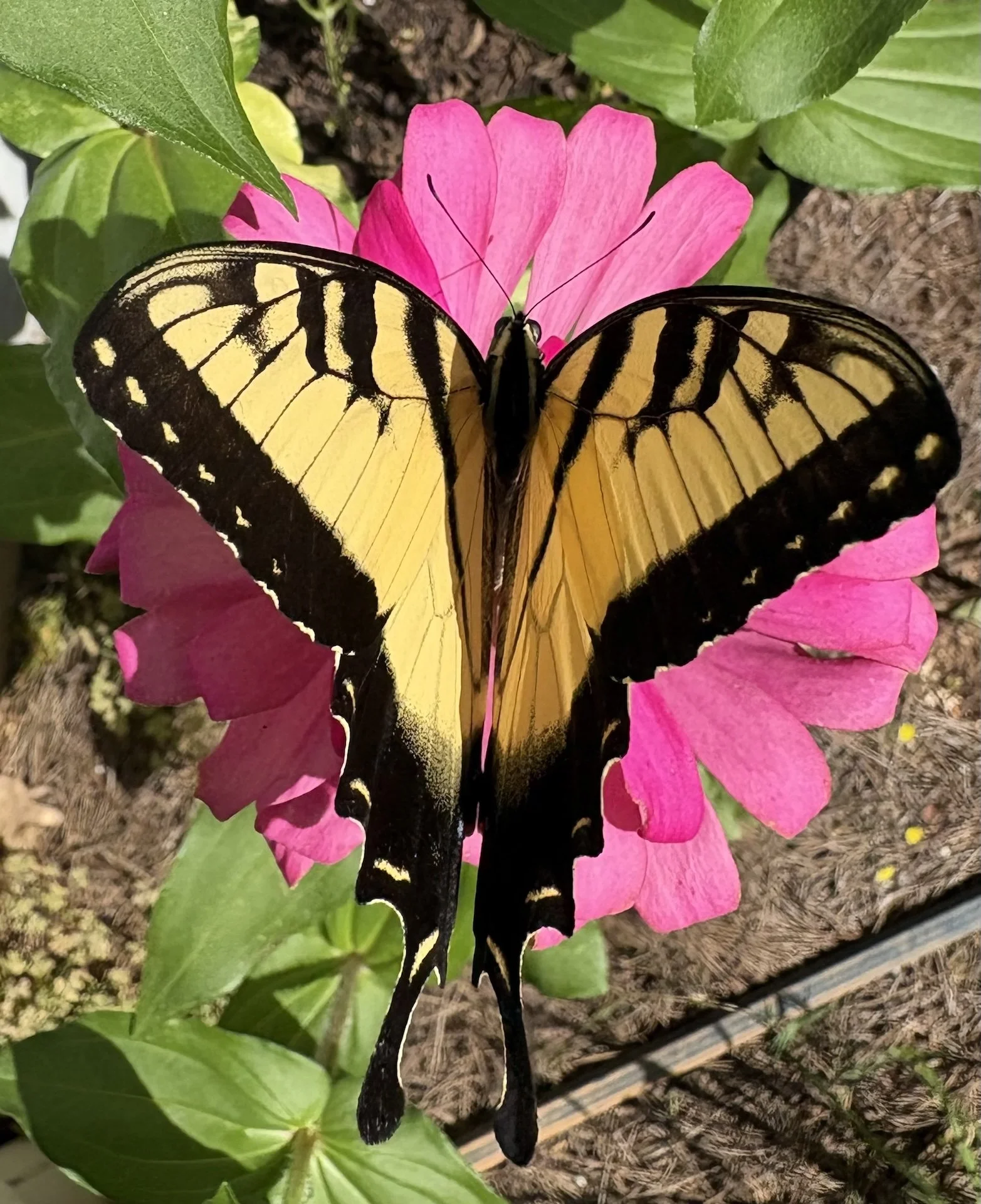
Swallowtail butterfly sipping nectar from a zinnia flower
Isn’t it magnificent how nature offers such a literal and potent exemplar for the process of becoming?
Personally, I have been in the soupy goo stage most of this summer, and I have certainly felt my “immune system” attempting to subdue the “imaginal disc cells” in my being. But alas, they seem to have survived! Right now, I feel like the crumpled butterfly just emerging from the chrysalis, hanging upside down, getting ready for my wings to expand.
While in this goo-like space, I have felt my varied roles and identities in the world peel off and dissolve. It’s been raw and disorienting at times. Tending to supportive practices like journaling, walking, and meditating have kept me tethered to the imaginal disc cells within me as they slowly multiply and divide.
I have also been staying close to the essence of what Tend Your Self wants to be in the world. What remains clear to me is that tending is the practice. Tending is activism. When the news of the day makes me want to throw up my hands, tending seems like the most salient, accessible action to take.
It’s quite an understatement to say that our world needs some serious tending right now.
As I think about where and how to start tending, David Whyte’s poem, “Start close in”2 comes to mind as it instructs “Start close in, / don’t take the second step / or the third, / start with the first / thing / close in, / the step / you don’t want to take.”
Starting close in, I think about what is universally closest to each of us: our body. As a source of pleasure as well as pain, the body most certainly elicits a vast spectrum of complex emotions, opinions, and experiences that are unique to each of us.
In our current societal landscape where we are inundated with information, stimulation, distraction, and pressure to produce, detaching from our bodies is a natural survival strategy. Our body may signal that its tired or hungry, but we have a deadline to meet, so we drink some caffeine or eat a protein bar and keep going. Our body ripples with anxiety and dread, but attending to those signals might risk our livelihood, our reputation, and even our sense of self. Tamping down these sensations and doing our best to carry on often feels like the only way to keep up with the demands around us. In the rare moments where we might be without interruption or stimulation, sitting quietly with our body can feel disorienting and uncomfortable.
That said, a tending practice would be incomplete without first foraging a connection with the body — your body.
Over the past year, I have begun learning and practicing how to facilitate Somatic Experiencing©️. Somatic Experiencing is a body-based practice that focuses on exploring and experiencing the sensations of the body; somatic comes from the Latinized version of the Greek word “sōmatikos” which means “of the body”.
Unlike our word and image-laden minds, our body communicates purely through sensations. We can notice a lot as we observe the rhythm of our heart, our breath, the contraction or expansion of our muscles, as well as sensations like tingling, heaviness, lightness, and so many more.
Foraging a connection with your body’s sensational landscape can be compared to a journey or a trek. Just as you would not enter unfamiliar terrain brazenly, we heed the same caution as we enter the body. A somatic facilitator can serve as a guide, helping you explore your inner terrain with care, caution, and attentiveness. In the beginning of somatic awareness practice, a lot of the experience is about noticing sensations of comfort and ease. I like to think of this like setting up a base camp where you can recover if the terrain becomes too intense. By first locating and tuning into pleasant and comfortable sensations in the body, you have a foundation to return to when less pleasant feelings and sensations emerge.
My personal experience is that somatic awareness allows me to have an honest relationship with my self; tuning into my body’s sensorial landscape gives me access to my felt experience of the world, and noticing my body’s signals helps me know when something is a clear yes, a clear no, or simply foggy (helping me know to stay still for now). This example is just a small dimension of what can open up when we partner with the body through sensorial, somatic awareness.
I have started to refer to this sensorial approach of tending our selves as embodied tending because it invites the body into the tending practice. Embodied tending merges tending - offering care and attention - with presence and conscious awareness of the body’s felt internal experience.
In the same way the boy in The Alchemist remarks that “the caravan and the desert speak the same language,” as we practice embodied tending, we learn to speak the same language as our body. As we learn to incorporate the language of our body into our daily life and practices, we have access to an immense inner navigation system that can guide us across the terrain of life and — hopefully — to our metaphorical oasis.
The practice of embodied tending feels particularly pertinent right now. Of course you are well-practiced in bodily connection! You certainly know when you need to eat, sleep, and use the restroom. You may notice your breathing at times. And you have likely engaged in a body-centric activity like exercising, dancing, singing, or art making. Whenever you connect with your body and its multiplicity of sensations, you are practicing embodiment. When you bring presence, attention, and conscious awareness to these sensations, you are practicing embodied tending.
In The Alchemist, the alchemist himself reveals that it is a sliver of the Philosopher’s stone, which resembles a yellow egg that “turns any metal into gold” when added to the liquid of the melted base metal. While it may be a stretch, I would like to play around with the idea that embodied tending — offering presence and awareness to the sensational landscape within our body — is like adding a sliver of that Philosopher’s stone to our raw life material. As we stay present with our sensations and allow them to meld with our raw life material, we can trust that transmutation is underway.
I have so much more to share about embodied tending, and if you’ve made it through to the end of this newsletter, thank you for your attention. What I have shared here underpins the ethos of what I plan to offer through Tend Your Self. Just to reiterate, tending your self is not selfish. In the same vein that we know that we must put our own oxygen mask on first before helping someone else and that we “cannot pour from an empty cup,” when you tend your self, you naturally, effortlessly, radiate your well-tended self and your unique gifts and talents from a well-resourced space within you. When you are well-tended, everyone and everything around you benefits as you are able to be fully present and alive with life.
I’m curious: Where does this letter find you in your journey? What raw material are you tending to in your life? What phase of the butterfly’s life are you in right now?
I would love to hear how these ideas land for you and how you relate to them.
Do you know someone who is in the midst of a metamorphosis or who has supported you during yours? Consider sharing this email with them
In the spirit of embodied tending and the upcoming seasonal transition to fall/autumn, I have a couple of offerings on the horizon — it would be wonderful if you can attend!
✨If you are interested, please contact me and let me know! I will have an official registration link available soon✨
September Events
🍂 Fall in! Attune, connect, & co-create with the fall energies 🍂
When: Sunday, September 20, 2026, 10:30am - 12:00 pm
Where: Zoom (link will be sent out when you register)
Cost: $15 - 30 (sliding scale)
The air is getting breezier, the first leaves are changing color and beginning to fall, and the plants and trees are putting out their fruits and seeds. This time of year is nostalgic and bittersweet as we feel relief from the intensity of summer while knowing we are about to shift into the darker, more barren days of the cooler months.
During this seasonally-inspired workshop, we will connect with nature’s seasonal, cyclical rhythm as we invite nature in as a guide. Together we will explore and reflect on some themes present in nature during this time of the year:
gathering and harvesting
letting go and composting
remembering
We will also create space for somatic awareness as we invite your body’s senses and sensations in the reflection and exploration process.
There will be time at the end for intention setting for the season ahead, and you will leave the workshop feeling ready to embrace the Autumn Equinox on September 22.
💚 Tend Your Self from the Inside Out: Introduction to Embodied Tending 💚
When: Wednesday, September 30, 2026 from 7:00pm - 8:30pm
Where: Zoom (link will be sent out when you register)
Cost: $15 - 30 (sliding scale)
Throughout every moment of your life, your nervous system scans and processes the environment around you to keep you alive.
Unlike your mind that thinks and reasons through words and images, your nervous system communicates through sensations within your body: the tingling or goosebumps you feel when something moves you deeply, the butterflies in your stomach when you are nervous, or the pinch of a gut feeling.
Our body’s nervous system and its sensations are our most trustworthy compass as we navigate life. But many of these sensations go unnoticed as the demands of everyday life — busy schedules, deadlines, obligations — alongside the endless stream of information and sensory input — disconnect us from our body’s signals. Also, it’s important to mention that stress and trauma can make the body feeling uncomfortable and inhospitable.
So how do we create a bridge back to our body? We do it tenderly and with great care and consideration. We enter the body like we would unfamiliar terrain, and it’s a good idea to be accompanied by a guide.
As a somatic facilitator and guide, I will gently orient you to your nervous system during this introductory class. You will learn the basics of tracking and paying attention to sensations both inside and outside your body, and you will create a sensory-based resource that can serve as a refuge that exists within you — you can carry it wherever you go!
The skills we cover in this class serve as a foundation for cultivating an tending practice that nourishes you from the inside out.
Remember, tending your self is not selfish — when you are well-tended, you effortlessly radiate your light and gifts out into the world around you.
✨ 1:1 Facilitated Tending Sessions ✨
Are you going through a transitional time and/or a metamorphosis? 1:1 sessions are co-creative space where we get curious, reflective, and (as you're comfortable) invite your nervous system and body's wisdom into the self tending process. Contact me if you'd like more details and/or to schedule a free exploratory call.
Sending you lots of tenderness and care as we move through these final summer weeks.
References
1 I used the following sources to dig into the butterfly's life cycle:
Scientific American: https://www.scientificamerican.com/article/caterpillar-butterfly-metamorphosis-explainer/
BBC Science Focus: https://www.sciencefocus.com/nature/what-actually-happens-when-a-caterpillar-becomes-a-butterfly-is-it-a-pokemon-situation-or-more-of-a-cronenberg-thing
Free school: https://www.youtube.com/watch?v=TvmQiWpgX5c&t=81s
2 David Whyte: https://davidwhyte.substack.com/p/start-close-in-78b
